AI-Powered Podcast App in 7 Days
2025 was the year of increasing personal productivity with AI—using tools like Claude to write faster, research smarter, and automate tedious tasks. But 2026 is about something different: increasing the productivity of AI agents running in parallel for you. Not just one AI assistant, but swarms of agents.
A week ago, I had an idea: build an open-source Podcast 2.0 player optimized for GrapheneOS with natural language AI queries.
I have zero Android development experience. None. Nada. But I do have decades of experience with systems design.
Today, I have a working Android app with 50+ commits, 38 GitHub issues tracked, and features I couldn’t have implemented alone in such a short time.
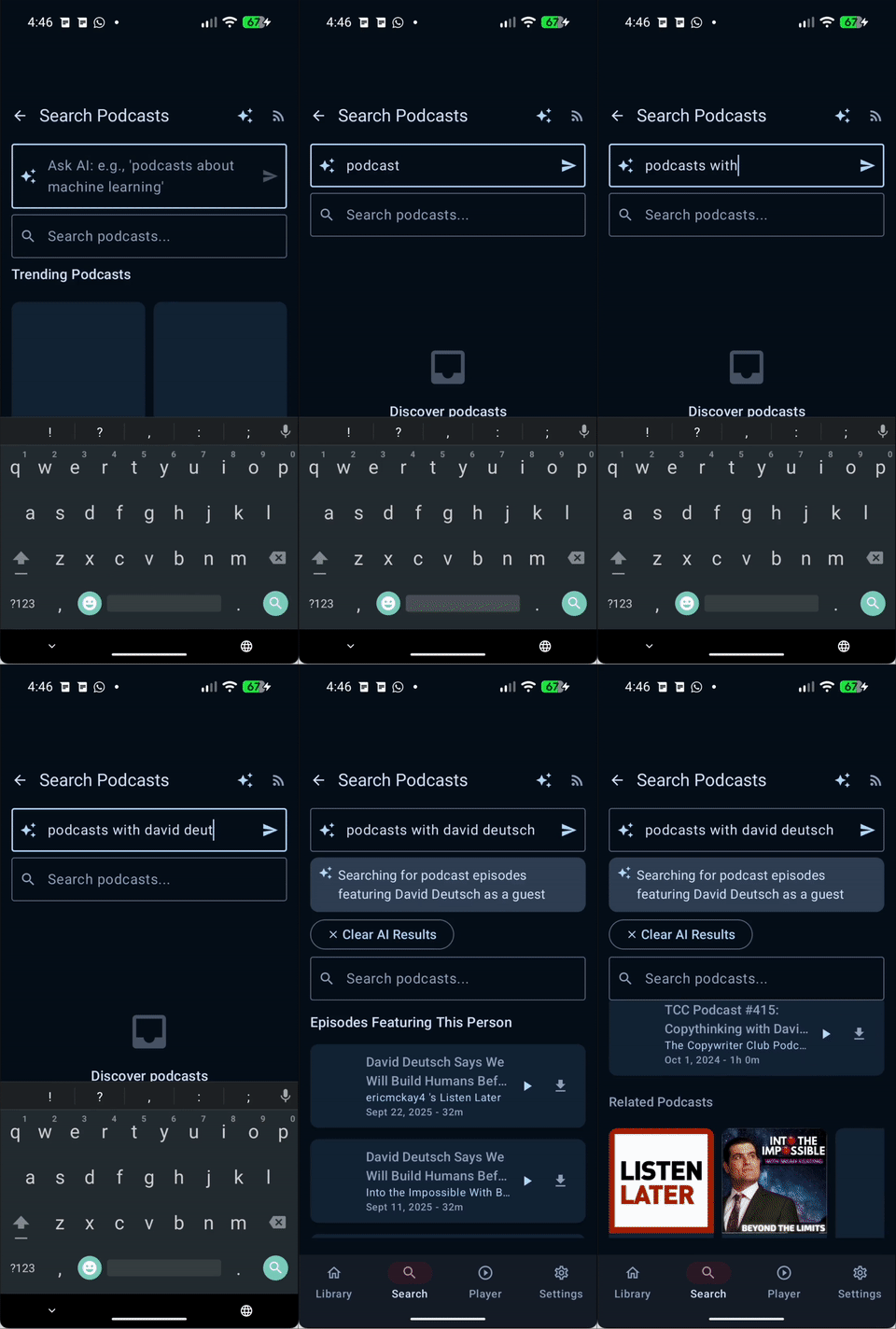
The Design Phase: Perplexity as Architect
It started with a conversation in Perplexity. I described what I wanted: a privacy-first podcast app with MCP (Model Context Protocol) integration for natural language search powered by my PodcastIndex MCP Server:

Over several exchanges, Perplexity helped me architect the entire system—five architecture documents covering everything from database schemas to API specifications. The Podcast Index provides an open, community-driven podcast directory—no Big Tech gatekeepers. My MCP server wraps their API with tools that Claude can invoke naturally.
The output included complete SQLite schemas and a three-tier LLM strategy (offline pattern matching, local Ollama - not implemented yet, and Claude API).
The AI Toolchain: Orchestration and Issue Tracking
Two tools made parallel AI development possible:
Claude-Flow orchestrates multiple AI agents working simultaneously—specialized coders, testers, and reviewers operating as a coordinated swarm. A coordinator agent manages task distribution while workers tackle their domains in parallel: one implements database entities, another builds the API client, a third creates playback controls.
Beads helps solve context management for AI agents. Otherwise, agents keep forgetting where they are like Guy Pearce in Memento. Beads creates tiny, focused issues that AI agents can consume without overflow. Each issue is a compact unit: short title, minimal description, labels. Beads also supports automatic compacting, condensing resolved issues into summaries.
The Android Stack
Remember—I’d never built an Android app before. The AI agents configured the entire toolchain: build.gradle.kts with dependency management, Kotlin compiler options, Android SDK versions, and Jetpack Compose. They generated a project structure following best practices: MVVM architecture, Repository pattern, Room database, and Hilt dependency injection.
The agents also created 272 Espresso UI tests covering core user flows. I ran these on the Android Emulator on my laptop—no physical device required. When tests fail, they capture screenshots showing exactly what went wrong.
Current Status
Completed: Podcast search and subscription, episode streaming, offline downloads, playback speed controls (0.5x-3.0x), AI-powered search, Claude API integration, encrypted credential storage.
Outstanding:
- GH#28: Background playback stops after ~1 minute (critical)
- GH#38: Single episode download from search results
- GH#22: Android Auto support
- GH#8: Full MCP server integration
Try It Yourself
Download APKs from the GitHub Releases page. The latest alpha (v0.1.0-alpha.34) includes all current features.
Links:
Lessons Learned
AI-assisted development requires clear direction and experience/skills in design and architecture. It’s still not ready for prime-time production, but inconsequential apps and prototypes are perfect. The human still makes architectural decisions and reviews output—but the execution speed is remarkable.
The biggest mental shift? Thinking in parallel. I kept catching myself working through GitHub issues sequentially when I could spawn up to eight agents simultaneously, each tackling a different issue. Old habits die hard.
I also had to upgrade my Claude account to the Max plan to handle the volume of agent requests. This makes it either the world’s most expensive podcast app or the world’s cheapest developer team—depending on how you look at it.
This project is experimental and incomplete—but as a proof of concept for AI-assisted development at scale, it’s exceeded my expectations. If I can build an Android app with zero prior experience in days, what could you build?
Built with Claude, Claude-Flow, Beads, and the Podcast Index. No tracking. No analytics. Just podcasts.